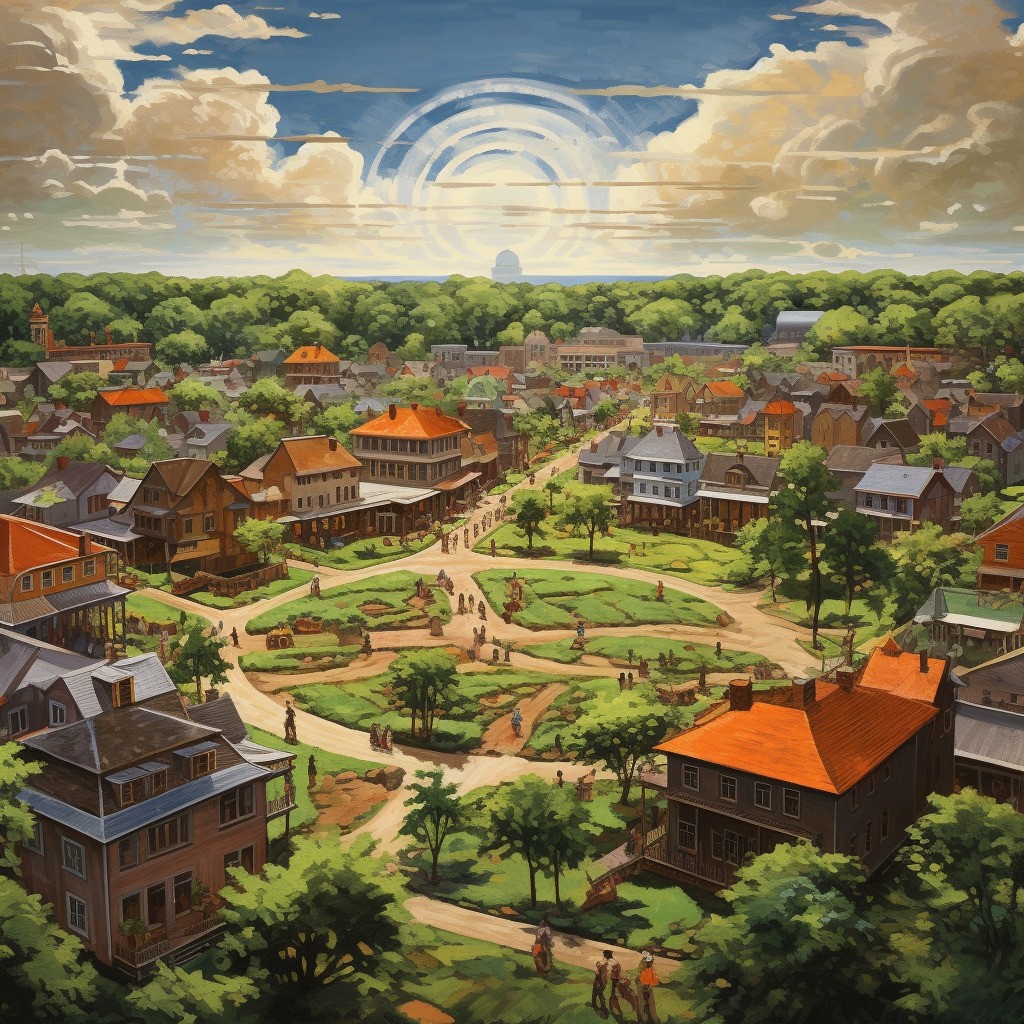
The land of Nephi lay south of the land of Zarahemla, divided from it by a narrow strip of wilderness that ran from the sea east to the sea west (Alma 22:27). It sat at a higher elevation than Zarahemla: the record consistently describes travelers going up when heading south to Nephi and coming down when returning north to Zarahemla (Mosiah 7:2–6; 8:2; 9:3; Alma 17:8; Omni 1:13). On the western shore, in the land of Nephi, was the place of the fathers’ first inheritance, where Lehi’s family had first settled (Alma 22:28). Aaron, one of the sons of Mosiah², found the Lamanite king who reigned over all this land except the land of Ishmael (Alma 22:1).
The land was agriculturally productive. The Nephites raised flocks and herds and sowed corn, wheat, barley, neas, and sheum (2 Ne. 5:11; Mosiah 9:9). Nephi¹ built a temple there after the manner of Solomon’s temple, though without its costly materials, which were not found in the land (2 Ne. 5:16). The Nephites settled and held the land from roughly 590 to 200 B.C.; thereafter the Lamanites held it for the remainder of the recorded history (Omni 1:12–13).
The city of Nephi, also called Lehi-Nephi, was the principal settlement, founded by Nephi¹ after he separated from his brethren and later occupied by the Zeniffite colonists under Zeniff, Noah³, and Limhi (Mosiah 9:8). When Mosiah’s men set out from Zarahemla to find these colonists, they wandered forty days before reaching a hill north of Shilom, then went down into the land of Nephi (Mosiah 7:2–6; cf. 9:3). Events recorded in the land include Jacob²‘s prophecies, the preaching of Abinadi, the conversion of Alma¹ and his establishing a church at the waters of Mormon, the bondage of Limhi’s people, and the missions of Ammon and Aaron to the Lamanites (2 Ne. 5:16; Alma 17–26; Mosiah 9; 11; Mosiah 17:2; 18:4–5, 16).
The surrounding territories appear to have been small. Noah³ built a tower from which he could overlook the lands of Shilom and Shemlon, and Limhi later watched the Lamanite army approach from the same tower (Mosiah 11:12; 19:6; 20:7–9). Neighboring lands lay within a few days’ travel: pursuers tracked Limhi’s people for two days before losing them in the wilderness, and Amulon’s group, searching for the land of Nephi, came upon the land of Helam (Mosiah 22:16; 23:30–31, 35).
A Lamanite city in the region was called Jerusalem, after the city of their fathers’ nativity, and lay adjoining the borders of Mormon; near it was a village called Ani-Anti (Alma 21:1–2; 21:11). The waters of Mormon, a fountain in a forest near the city, were where Alma¹ baptized about two hundred and four converts (Mosiah 18:8, 16). The city of Jerusalem, along with the city of Gilgal, was later sunk and covered with water at the time of the crucifixion (3 Nephi 9:6–7).