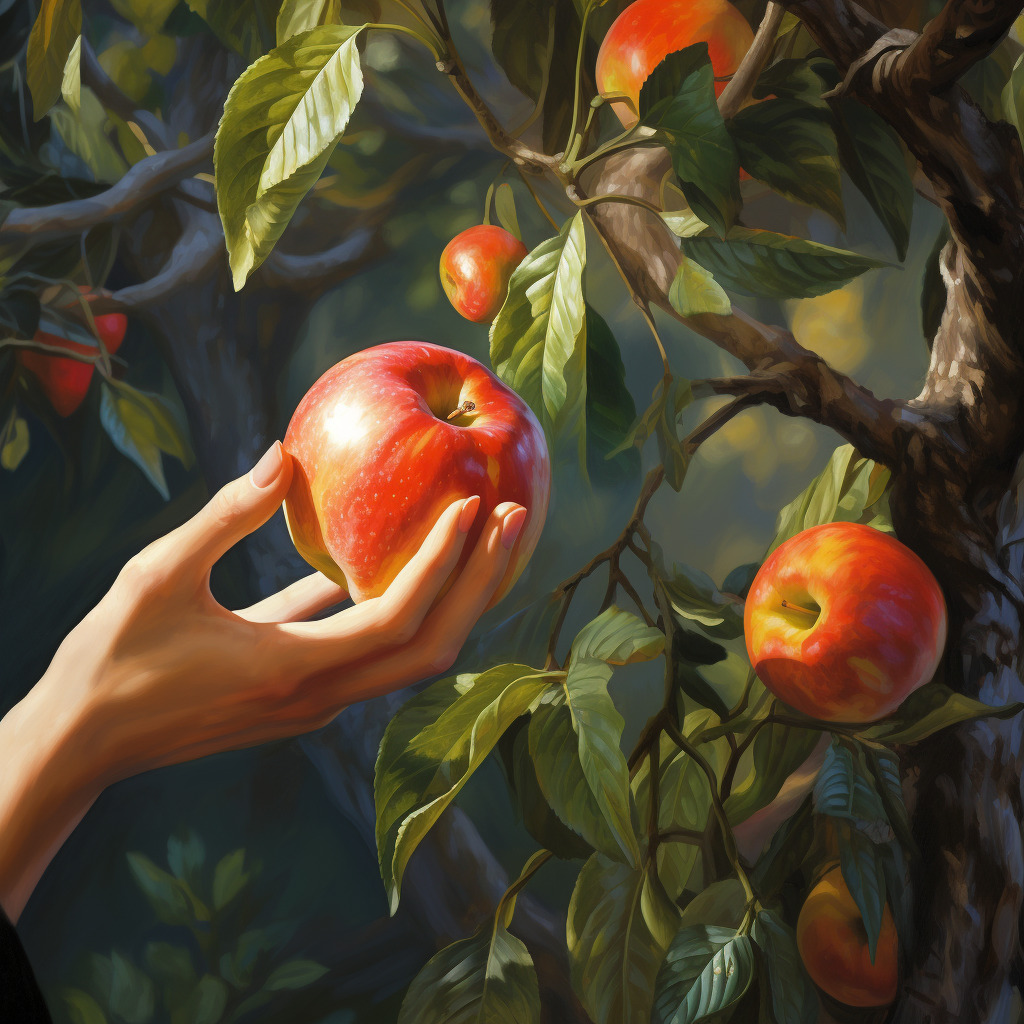
Eve was the first woman, named by Adam “because she was the mother of all living”; the Lord calls her the first of all women (Moses 4:26). The brass plates that Nephi obtained on leaving Jerusalem contained the five books of Moses, which gave the account of the creation and of Adam and Eve as the first parents of humankind (1 Nephi 5:11).
Lehi taught that after the creation of the first parents there had to be an opposition, “even the forbidden fruit in opposition to the tree of life,” so that man could act for himself (2 Nephi 2:15). The devil, “that old serpent,” told Eve to partake of the forbidden fruit, saying she would not die but would be as God, knowing good and evil (2 Nephi 2:18). After Adam and Eve partook, they were driven out of the garden of Eden to till the earth, and they brought forth children, the family of all the earth (2 Nephi 2:15-20). Lehi further reasoned that without the transgression of Adam and Eve there would have been no children, and the first parents would have remained in a state of innocence, “having no joy, for they knew no misery” — concluding that “Adam fell that men might be; and men are, that they might have joy” (2 Nephi 2:22-25).
Alma taught that the Fall cut the first parents off both temporally and spiritually from the presence of the Lord, and that cherubim and a flaming sword were placed at the east of the garden to keep them from the tree of life, granting instead a probationary time to repent (Alma 42:2-15). The command to the first parents was to “multiply, and replenish the earth” (Genesis 1:28).