St. Louis Republican
1884-07-16
St. Louis Republican
❮ Community

| 
Vol. LXXVI.
St. Louis, Wednesday, July 16, 1884.
No. ?

REVELATION REVISERS.
> Interest has been revived in questions relating to the origin of the Church of the Latter Day Saints and the
> authenticity of the manuscript from which the Book of Mormon was printed, and which is now being compared with the
> various editions of that book by a commission now sitting at Richmond, Mo. Dispatches to the REPUBLICAN
> a week or two since gave an account of the proceedings of the commission, but other dispatches, stating
that
> the commission was composed of a delegation from Utah, and representing that the work of comparison is being
> done from parchment and from the original plates, with other glaring mistakes, is almost too absurd for refutation.
> It has been known for many years that the original manuscript, as dictated by Joseph Smith, and from which the first,
> or Palmyra (N.Y.) edition of 1830 was printed, has been in possession of David Whitmer of Richmond, who was one of the
> original, and only surviving witness of the revelator's work. It is known to many that the church authorities of Salt Lake
> have made overtures to Mr. Whitmer to get possession of the manuscript, b
ut without avail, he holding the document as a
> sacred deposit.
>
> A VISIT TO RICHMOND.
>
> To carry out a purpose contemplated for some time, a REPUBLICAN representative took the train at St. Louis, and
> arriving in Richmond next morning, he was driven through a portion of that beautiful town, now fully recovered from the devastation
> caused by the cyclone of 1878, and set down at the Wasson House. Nearly the first man struck happened to be Mr. David J. Whitmer,
> the son of David Whitmer, to whom the purpose of the visit was made known. Mr. Whitmer stated that owing to the advanced age and
> feeble condition of his father's health, the family had objected to visitors out of a feeling of curiosity calling on the old
> gentleman and interrogating him on these matters.
He objected to these visits, and though his memory was unimpaired relating to
> bygone events, it was rather unpleasant and did no good. The commissioners were in session at his house, and it was for them to say
> whether they desired to be interviewed, but as for seeing the old man it would be better to get Mr. Farris, Gen. Doniphan or Col.
> Childs, old friends of his, to be introduced. The Hon. John T. Farris, the well-known and able representative from Ray county in
> the legislature, was readily found at his law office, and with him a call was made at the residence of Mr. Whitener. He occupies a
> tasty looking frame dwelling, which was nearly destroyed by the great cyclone and has since been rebuilt.
The old gentleman was at
> work in his garden when the cyclone swept over the town, and was wounded on the head by a flying missile. He is well fixed, with
> pleasant surroundings, having been engaged in the livery business, from which he has retired with a competency. The walls of the
> lower parlor are ornamented with a few pictures, among which is a portrait taken of Mr. David Whitmer when he was thirty-five years
> of age, betokening a more robust health, florid face, and determined energy. The portrait of his wife hangs by the side, a pleasant
> beauty, who is still alive and going down the hill-side of life the cheerful companion of her husband.
>
> Word was brought down that Mr.
Whitmer was engaged with the commission, and the invitation was extended to call on him there, as
> he felt too feeble to walk down stairs. Mr. Whitmer was found in the chamber above, lying on his bed in a room adjoining the commission,
> and communicating with it by an open door.
>
> THE WITNESS OF THE REVELATION.
>
> The old gentleman rose from the bed and received his callers very cordially. In person he is above medium height, very lean and
> feeble, and, with stooping shoulders, bears the marks of advancing age, being now in his eightieth year. The lips are drawn in, from
> the absence of the teeth, and he converses in a tremulous voice. So great is the change that he would hardly be identified from
> his picture taken in early manhood, during the glowing vigor of health.
He said he was ready to respond to inquiries of his past
> history, but intimated that it had all been published, and, as for that portion connected with his sojourn in Missouri, there was
> so much of it that he did not wish to go over it again. He preferred that such information as was desired should be obtained from
> the gentlemen composing the commission, and thereupon the callers, accompanied by Mr. Whitmer, entered their room.
>
> THE REVISERS.
>
> At one end was a table around which the ministerial conclave was seated, each holding a book, except one of the members, who was
> reading from a manuscript. It was a convocation of men whose labors would doub
tless he handed down in the church as a memorable
> event, that of verifying the various editions of the Book of Mormon from the original manuscript, in the presence of the only
> surviving witness of this great revelation to man. As Mr. Farris and the REPUBLICAN representative entered the room
> these holy men suspended their work, and rising to their feet, the former were introduced to President Smith and by him were
> introduced to the other members of the board. The reception was extremely cordial, and while Father Whitmer, in his feeble state,
> extended himself on a bed near the table, the commissioners participated in a running conversation for half an hour. The following
> are the members of the commission: Rev.
Joseph Smith of Lamoni, Decatur county, Iowa, president of the Reorganized Church of Jesus
> Christ, commonly called Latter Day Saints, and editor-in-chief of the Saints' Herald. He is the eldest son ofJoseph Smith
> the prophet and inspired translator of the Book of Mormon from the golden plates.
>
> William H. Kelley of Kirtland, Ohio, missionary in charge of Michigan, Northern Ohio, Western New York and Western Ohio mission.
>
> Alexander H. Smith of Independence, Mo., missionary in charge of Pacific Slope mission, comprised of California, Oregon and Nevada.
> He is the second son of the prophet, Joseph Smith.
>
> Thomas W. Smith of Independence, Mo., mi
ssionary in charge of Australian mission, including Australia and Society islands and other
> Polynesian isles.
>
> The three last named are a committee appointed by the general conference of the reorganized church, held at Stewartsville, Missouri,
> April 6 to 15, 1884, to compare the Palmyra and the current editions of the Book of Mormon with the original manuscript now in the
> hands of David Whitmer of Richmond, Ray county, Mo. The object of the examination is to discover whether there are differences as
> alleged by some between the printed edition and the manuscript. They have been engaged in the work for five days up to Monday night,
> and expect to spend some three days more, closing Wednesday night.
>
> HOW THEY DO IT.
>
> The Manuscript of the Book of Mormon.
-- The manuscript held by "Father Whitmer," as he is designated by the commission, is handed
> out in sections, the leaves being firmly held together. It is the original from which the Palmyra or first edition was printed in
> 1830, and bears very plainly the printer's marks. The manuscript, which was examined by the reporter, is common, rather coarse
> foolscap in use fifty years ago, and the penmanship is in a medium hand, plain and perfectly legible. It appears that some five
> different persons were engaged in writing the document as Joseph Smith dictated the subject matter. Father Whitmer,
> who was present very frequently during the writing of this manuscript, affir
ms that Joseph Smith had no book or manuscript before him
> from which he could have read as is asserted by some that he did, he (Whitmer) having every opportunity to know whether Smith had
> Solomon Spaulding's or any other person's romance to read from. The commission have before them various editions of the Book
> of Mormon, first and most important the original Palmyra edition of 1830. Then there are the Kirtland edition of 1835 [sic], the
> Nauvoo edition of 1843 [sic], the Plano (Ill.) edition, and various editions published by the polygamists of Salt Lake City. There
> are also five European editions published in England, Denmark and Sweden, Germany and France.
One of the commission said it must be
> stated in behalf of the Salt Lake edition that they have made no changes from the original manuscript, except what may be said of
> other editions, and these consist merely of changes in verbs and tenses. Whenever an alteration is detected which consists, for
> instance, of the substitution of the relatives, who, which and that, and the tenses of the verbs, the person holding the edition in
> which such change is detected erases the word and substitutes the original word as it exists in the manuscript, interlining the
> correct word in the printed book with a pencil. The intention is probably to print an edition, thus corrected fro
m the manuscript,
> which will be recognized as genuine at least by the Reorganized Branch of the saints.
>
> HE WILL NOT GIVE IT UP.
>
> It is well known that some years ago [Orson] Pratt and Joseph F. Smith, the son of Hyrum Smith of the Salt Lake branch, came
> to Richmond, and calling on Father Whitmer offered him any sum he would name (the amount being stated at $100,000) if he would
> surrender to them the original manuscript. They said they wanted the manuscript solely for the purpose of placing it in the archives
> of the church at Utah for preservation. Mr. Whitmer informed them that he would not part with it for any amount of money. He was
>
its custodian, and it should be preserved as a sacred deposit by himself and heirs.
>
> The latest edition of the Book of Mormon has been verified the same as was done with the Bible, for convenience to the reader.
> The manuscript was written from the dictation of Joseph Smith by the following amanuenses: Oliver Cowdery, Emma Smith, wife of Joseph
> Smith; Christian Whitmer and Martin Harris, and it is supposed that Alva Hale was also employed as one of the scribes, but Hale only
> wrote a small portion.
>
> HOW WHITMER GOT IT.
>
> Oliver Cowdery, the principal witness and scribe of Joseph Smith, became the possessor of the manuscript[s] which he retained and
> brought with him to Missouri.
Oliver Cowdery was the brother-in-law of Jacob Whitmer, and he died at Richmond in 1850, in the house
> adjoining Whitmer's, and the latter naturally came in possession of the document. Oliver Cowdery is buried in the old cemetery, near
> Richmond, and his wife and daughter are still living in this state.
>
> For the brief time that the commissioners were disengaged there was a good time for interviewing, but there were too many of them
> at once, and, like the fowler distracted by the flocks of pigeons on the trees, in the wheat stubble, with others flying overhead,
> shots were rather scattering.
>
> PRESIDENT JOSEPH SMITH.
>
> President Joseph Smith is a gentleman of rather imposing appearance, well built, piercing eyes and dark beard mingled with gray,
> flowing down below the chin in patriarchal length.
In physical appearance he is quite as striking as the late President Garfield,
> whom it is said he resembles, and possesses much of the same magnetism. He is good looking, and Gen. Doniphan informed the reporter
> that he takes after his mother, a fine looking lady, whom he knew well. He is withal a stout looking man, weighing 210 pounds and his
> height is five feet eight. He stated that he was born in Kirtland, O., and is about fifty-one years of age. He remembers his father
> who was kind and indulgent to his family. He studied law in Canton, Ill., with Judge Kellog, but becoming averse to the practice of
> law he studied for the ministry, and is now the head of a church numbering some 20,000 members, and known as the Reorganized Church
> of the Latter Day Saints.
That branch has no affiliation with the Salt Lake Mormons or Brighamites.
>
> "They are the only class," said Mr. Smith, "of ministers who won't meet us in discussion. You can't get one of their churches in
> Salt Lake to let one of our men in, but they will let in a Methodist and the preachers of other denominations. In 1869 Brigham
> Young refused my brother here, Alex. H. Smith, the use of the Tabernacle because, as they said, we were trying to undo the work
> they had done -- that is, tear it down. They don't deny Joseph Smith, my father, but they claim he originated polygamy, in the
> church. We challenge the proofs."
>
> The attention of Mr. Smith being called to the widespread belief that his father pirated the Book of Mormon, which was none other
> than a romance written by Rev.
Solomon Spaulding, he scouted the idea as utterly ridiculous and absurd. Addressing himself to Mr.
> Ferris, as a lawyer, gave him a very detailed history of the case, showing by dates and other undeniable facts of history the utter
> absurdity of the charge. He was willing to submit these facts to any judge or jury in the country and they would come to the same
> conclusion. He showed Sidney Rigdon, who is alleged to have got possession of Spaulding's manuscript in a printing office at Pittsburg,
> Pa., was but ten [sic] years of age at the time, and is not likely that a boy would understand the nature of such an acquisition.
>
> WHITMER'S TESTIMONY.
>
> While president Smith was wrestling with the charges of fraud and delusion urged against his father, the REPUBLICAN
> representative turned to Mr.
Whitmer, who was lying on the bed and listening with much apparent interest to the colloquy, occasionally
> interposing a word in confirmation of Mr. Smith's statements and made some interrogatories.
>
> "Yes," said Mr. Whitmer, "I have no objection to giving the particulars of my early life. I was born near Harrisburg, Pennsylvania,
> at a small trading post, in 1805. My father moved to York state when I was four years old. We settled in Fayette township, Seneca
> county, between Seneca and Cayuga lakes, four miles from Seneca Falls, two miles from Waterloo, seven miles from Seneca. I lived
> there till I was twenty-six years old. The first time I saw Joseph Smith was in Harmony, Pennsylvania I joined him before the Book of
> Mormon was printed at Palmyra, N.Y.
I was there during the time the book was printed. The translation was done in my father's house;
> at least two months of the time, was thus taken up with it there. Oliver Cowdery was the principal amanuensis. Cowdery died in
> [1850], near my house, in Richmond. I saw the stone which formed the box or receptacle in which the metallic
> plates were found, on the hillside, Commarah. Joseph Smith claimed that an angel informed him of the place where the plates
> were hidden. I saw the plates; they were bound together with leaves, and held together by rings, two at each corner of the bundle
> and one in the centre.
>
> "Joseph Smith dictated every word in the book. The understanding we have about it was that when the book was discovered an angel
> was present and pointed the place out.
In translating from the plates, Joseph Smith looked through the Urim and Thumminim, consisting
> of two transparent pebbles set in the rim of a bow, fastened to a breastplate. He dictated by looking through them to his scribes."
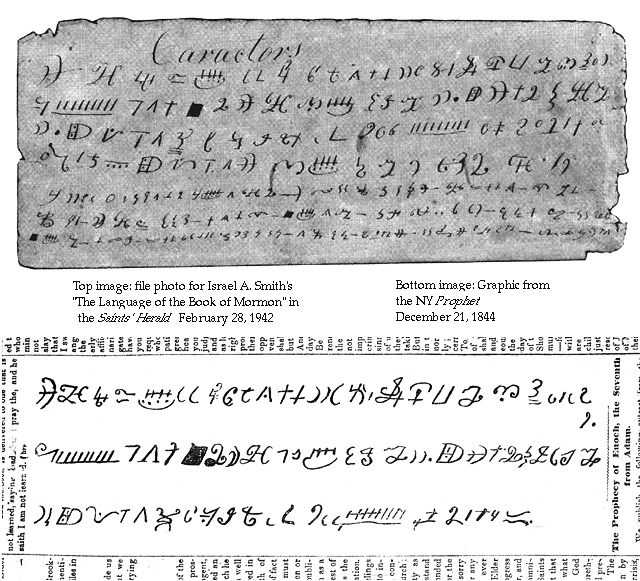
> At this stage of the explanation, Mr. Whitmer showed those present a
> specimen of the characters copied from the plates. It is on a
> piece of strong paper about four by eight inches, and covered with one hundred or more hieroglyphics and figures.
>
> THE HIEROGLYPHICS.
>
> It is the identical specimen which was sent to Prof. Anthon, of New York, and shown by him to Prof. Mitchell, of which the New
> York papers made mention at the time.
The specimen was
> sent to Prof. Anthon by Martin Harris and returned to him. Profs. Anthon and Mitchell both admitted they were ancient characters,
> resembling the reformed Egyptian and Hebrew characters. Mr. Whitmer holds these characters, as well as the manuscript of the Book of
> Mormon and the records of the church, in great reverence, and would not part with them for any money or allow them to go out of his
> house. He says he is utterly opposed to polygamy and remarked that when he was connected with the church in York State, "we
> wouldn't," he said, "have fellowship even with any person who was divorced, and Joseph Smith was opposed to it." Mr. Whitmer here
> desired his grandson, Mr.
George Schweich, to copy for the REPUBLICAN the following extract from the Book of Mormon
> as an expression of his views and that of the founders of the church:
>
> EXTRACT FROM THE BOOK OF MORMON.
>
> Book of Jacob, chapter II. -- "Behold David and Solomon truly had many wives and concubines, which thing was
> abominable before me, saith the Lord; wherefore, thus saith the Lord, I have led this people forth out of the
> land of Jerusalem, by the power of mine arm, that I might raise up unto me a righteous branch from the fruit
> of the loins of Joseph. Wherefore, I the Lord God will not suffer that this people shall do like unto them of
> old. Wherefo
re, my brethren, hear me, and hearken to the word of the Lord: For there shall not any man among
> you have save it be one wife; and concubines he shall have none; for I, the Lord God, delight in the chastity
> of women."
>
> Mr. Whitmer on being asked if he saw the angel, as stated in some accounts, opened the book and pointing to a section said, "There
> is my testimony. Read it; that tells all that is necessary for me to say about it. That contains the solemn testimony of myself
> and the other persons named." Mr. Whitmer's response was regarded as closing out any further interrogatory under that head,
> and an estoppel was put on such inquiries.
>
> THE
WITNESSES.
>
> Be it known unto all nations, kindreds, tongues and people unto whom this work shall come, that we, through the grace
> of God the Father and our Lord Jesus Christ, have seen the plates which contain this record, which is a record of the
> people of Nephi, and also of the Lamanites their brethren, and also of the people of Jared, who came from the tower
> of which hath been spoken; and we also know that they have been translated by the gift and power of God, for his voice
> hath declared it unto us; wherefore we know of a surety, that the work is true; and we also testify that we have seen
> the engravings which are upon the plates and they have been shown unto us by the power of God and not of man.
And we
> declare with words of soberness that an angel of God came down from heaven and he brought and laid before our eyes,
> that we beheld and saw the plates and the engravings thereon, and we know that it is by the grace of God the Father and
> our Lord Jesus Christ that we beheld and bear record that these things are true, and it is marvellous in our eyes.
> Nevertheless the voice of the Lord commanded us that we should bear record of it; wherefore to be obedient unto the
> commandments of God, we bear testimony of these things, and we know that if we are faithful in Christ we shall rid our
> garments of the blood of all men and be found spotless before the judgment seat of Christ and dwell with Him eternally
> in the heavens, and the honor be to the Father and to the Son, and to the
> Holy Ghost, which is one God.
Amen.
>
> Oliver Cowdery,
>
> David Whitmer,
>
> Martin Harris.
>
> The above is from the Book of Mormon. Now who among the Gentiles and sceptics of a later generation is to gainsay what is
> here written.
>
> AN ORIGINAL REVELATION.
>
> Revelation to Oliver Cowdery, David Whitmer and Martin Harris, June, 1829, given previous to their viewing the plates
> containing the Book of Mormon.
>
> 1. Behold I say unto you, that you must rely upon my word, which if you do, with purpose of heart, you shall
> have a view of the plates, and also the breastplates, the sword of Laban, the Urim and Thummim, which were
> given to the brothe
r of Jared upon the mount, when he talked with the Lord face to face, and the miraculous
> directors which were given to Lehi while in the wilderness, on the borders of the Red sea; and it is by
> your faith that you shall obtain a view of them, even by that faith which was had by the prophets of old.
>
> 2. And after that you have obtained faith, and have seen them with your own eyes, you shall testify of them
> by the power of God; and this you shall do that my servant, Joseph Smith, Jr., may not be destroyed, that I
> may bring about my righteous purposes unto the children of men in this work. And ye shall testify that you have
> seen them even as my servant Jos
eph Smith, Jr., has seen them, and it is because he had faith; and he has
> translated the book, even that part which I have commanded him, and as your Lord and your God liveth, it is true.
>
> 3. Wherefore you have received the same power, and the same faith, and the same gift like unto him; and if you
> do these last commandments of mine which I have given you the gates of hell shall not prevail against you; for
> my grace is sufficient for you, and you shall be lifted up at the last day. And Jesus Christ, your Lord and
> your God, have spoken it unto you that I might bring about my righteous purposes unto the children of men. Amen.
>
> It may be stated here that Mr.
Whitmer has in his possession the history written by the appointed historian of the church,
> John Whitmer (the brother of David). The history is still in manuscript and has never been published. John died, leaving
> the history in David's hands, and for aught known, it has been seen but by very few persons.
>
> It is further known that revelations became so frequent among the Saints from 1829 to 1835 that Joseph Smith received a
> revelation shutting down on this superabundance of heavenly oracles. The supply was greater than the demand. Mr. Whitmer,
> on being asked about these revelations,
>
> said most any one could get a revelation if he desired. He denounced the Book of Covenants that Smith,
> Sidney Rigdon and his associates claimed to have received, and which were published in Kirtland, O., in 1835.
Smith,
> he said, was generally opposed to these revelations, but being frequently importuned by individuals to reveal to them
> their duty, he was compelled to yield, and in this way the original purity of the faith was darkened by novel ideas.
> He maintains that the Book of Mormon is much more antagonistic to polygamy and concubinage than the Bible, "and Joseph Smith,"
> said he, "never to my knowledge advocated it, though I have heard that he virtually sanctioned it at Nauvoo. However, I
> broke loose from him in 1837 and can't state intelligently."
>
> ALEX. H. SMITH.
>
> This gentleman, the second son of Joseph the prophet, is stoutly built. His complexion, with the evidence of good health,
> is said to resemble his father more strikingly than any other of the sons.
Gen. Doniphan, who knew Joseph Smith confirmed
> the statement that Alex bears a striking resemblance to his father. Alexander informed the reporter that he visited Salt
> Lake in 1876, staying for three weeks. "I was refused permission to speak in the Tabernacle. They said they got the sanction
> of polygamy from my father, who died 1844, and that it was not till August, 185[2], that it was first presented in a
> special conference held at the tabernacle in Salt Lake City by Brigham Young. Orson Pratt gave the first in defense of
> polygamy ever uttered in a Mormon church. Illinois killed father as a reformer, the same as she did Lovejoy. Father was not
> an educated man, but after we moved to Ohio they had good schools there, and he improved himself so that he became, in
> some measure, quite learned.
We younger men know only about these things b[y] what we learn from our elders. Father Whitmer
> was there, and we accept his statement.
>
> THOMAS W. SMITH.
>
> This gentleman is a cousin of Joseph and Alexander, and in charge of the Australian mission. He is a gentleman of learning
> and extensive research in the literature of theology. He gave a running sketch of the Book of Mormon and what it taught.
> Mormon was the last of the race. The history told by him covers 600 years before Christ and extends 400 years subsequent to
> the beginning of the Christian era. After the departure from Jerusalem the Nephites and the Lamanites became divided and the
> Nephites in consequence of the turbulence and fierce wars were finally destroyed, except a portion who united with the deserters
> and were identified and absorbed by the Lamanites.
This colony came to this continent before Christ, landing as is supposed in
> Peru, South America. The description of the country in the Book of Mormon answers to the accounts given by modern explorers,
> and shows conclusively that they passed across the Isthmus of Panama. They afterwards scattered all over the country, leaving
> mounds, temples, tablets, statuary, inscriptions and other memorials of their occupation. It is a curious and noted fact that
> all the explorations made by Squires, Priest, Stephens and Catherwood and others of these remains of an ancient people were
> made subsequent to the publication of the Book of Mormon, which is the only book that gives the key to these prehistoric
> migrations.
The descendants of the colony which came out from Jerusalem discovered a colony that preceded them and which came
> out from the tower of Babel. Mr. Smith is about leaving very soon for the Australasian archipelagos, and will revisit New Zealand.
> He desired very much to see Mr. Griffin, the American consul to New Zealand, who, he saw from the Republican, was stopping at
> the Southern hotel; but as the commission will not complete its work until Wednesday evening of this week, he could not expect
> to find Mr. Griffin in St. Louis after that time. Mr. Smith, when asked by the reporter, if in New Zealand he would not be afraid
> to encounter the Maoris or missionary eate
rs, answered in the negative, and said the worst enemies that he expected to meet
> would be the Brighamites or polygamists from Salt Lake who had a large following in those islands, and whom they pitched into
> wherever met as hostile to the pure teachings of Joseph.
>
> WM. H. KELLEY.
>
> Mr. Kelley is a missionary in charge of the central states with headquarters at Kirtland, Ohio, where he ministers in the
> original temple first erected by the saints in this country. The temple was built after a design by Joseph Smith in 1834. The
> walls are of unhewn stone, three stories in height, 69 feet in length. The outside and inside is plastered with cement and the
> appearance is as fresh as when first built.
A peculiarity of the interior is that there are two pulpits, one at the east and
> the other at the west end. There are three pulpits or platforms in each of the main pulpits rising one above the other. Mr. Kelley
> avers that the church will stand forever as it is approved by the Almighty like the Pentecost. It has withstood the tribulation
> of the saints from the mob and from riots, Joseph and Sidney Rigdon having both been tarred and feathered by the people called
> the Campbellites. The late President Garfield resided about three miles from Kirtland. He was more liberal in his views and
> while officiating as a Campbellite preacher he performed the marriage ceremony of the late Judge Whitmer of Richmond, who was
> a nephew of David Whitmer.
The church at Kirtland comprises only six members, though the services are crowded by outsiders,
> mostly free-thinkers, and those who do not belong to any church. The pulpit of the temple is free to all denominations, and even
> Bob Ingersoll would be admitted, as they believe in freedom of conscience to its fullest extent. In February last, the
> great Braden-Kelley debate took place in the temple, the
> former being a Campbellite.
>
> THE SALT LAKE DELEGATION..
>
> Hon. Jacob T. Childs said: "About six years ago Orson Pratt and Joseph [F.] Smith, the son of Hiram Smith and nephew of Joseph
> the Prophet, came to Richmond, from Salt Lake for the purpose of verifying the book of Mormon as published with the manuscript
> in the hands of Whitmer.
After examining it they pronounced it to be the original manuscript of the book of Mormon. Mr. Smith
> said he recognized his aunt's (the wife of the prophet) handwriting as a part of it; also Oliver Cowdery's handwriting. Orson
> Pratt stated that the manuscript was very valuable to them and he hoped that Father Whitmer would keep it in a safe place, as
> the archives of the church would be incomplete without it, and they would pay anything within reason for it. The family of Mr.
> Whitmer feels that a curse would fall on them if they allowed it to go out of their hands, that the Almighty intended that they
> should keep it, and fearing that if the Salt Lake people got it they would interpolate it for their own purposes.
The Whitmers
> hold it as a sacred document not to be parted with on any consideration. It is remarkable with what pertinacity the man's family
> believe in it. Every branch of the Whitmer family is firm in the faith. Mr. Whitmer, after describing to me the golden plates,
> I asked him what he considered their value.
>
> "That was exactly," he replied, with animation, "what first struck Joseph Smith, and the angel hurled him down the hill,
> Commorah, and it was six months before Joseph obtained possession of the stone box that held the plates, and he also reiterates
> to me his having seen the angel and having heard the voice distinctly. What he had seen was to be relied on, and that his
> testimony in the Book of Mormon is correct in every particular.
The way that Smith got into the belief of his
> supernatural power was first by putting on the glasses, he saw his entire past history revealed to him." Mr. Whitmer left
> the Mormons on account of their devious transactions, and on account of his refusal to handle or have anything to do with the
> Kirtland money, for which he denounced them, and, leaving Far West, came to Richmond. The Mormon priesthood held a council at
> Far West and John Whitmer, brother of David, was the secretary of it. David was aware that he was being tried as an apostate, and
> had an understanding with his brother that, if the council decided favorably, he was to come outside and raise his hat, but if
> they decided against him, then he was to wipe his face with a handkerchief.
John finally came forth, and, wiping his face with
> his handkerchief, David knew that was a signal for him to leave, and, mounting his horse, he made his escape. After that what
> is known as the Mormon war took place. The Mormon flagstaff was shivered to splinters by a stroke of lightening, and this was
> considered a bad omen and frightened many of the Mormon followers. Father Whitmer during the war drove a wagon containing provisions
> for the supply of the Doniphan forces, and when he got to Far West the women came out and said Whitmer had done right in the
> course he pursued. The split there occurred, and Whitmer never went to Nauvoo, but remained here with the better class of Mormons.
> The Whitmers, the Pages and others regard the Book of Mormon as a continuation of the New Testament.
>
> FIRM BELIEVERS.
>
> This subject may be closed with the observation that, whatever the gentiles may believe in regard to the Mormons, the sons of Joseph
> Smith and David Whitmer and his sons believe in it with a firm conviction and undoubted faith. The honesty and excellent character
> of the Whitmer family are substantiated by the people of Richmond without exception. That David Whitmer, who holds many of the
> revelations of the early founders of that church with no higher esteem than outsiders, and the fact that he had a falling-out with
> Joe Smit
h and in a measure separated himself from the saints who went to Nauvoo, and still holds to the genuineness of the Book of
> Mormon with an unalterable faith in its truth is certainly a remarkable fact. Whitmer holds the Book of Mormon in the same estimation
> that he holds the Bible, believing that the one is a supplement of the other, and that whoever disbelieves in either does it at the
> hazard of his eternal salvation. That the supposition The supposition that
> the Rev. Solomon Spaulding wrote the Book of Mormon is absurd and "a weak invention of the enemy." A man
> who would put forth a book, however meritorious in other respects, as a novel eithout a plot, character or any
> of the essentials of a work of fiction, is censurable for his stupidity.
>
> Note: Matthew B.
Brown, in his 2003 book, Plates of Gold, quotes on page 152 this excerpt from the 1884 Republican
> article: "David Whitmer remarked, 'The way that Smith got into the belief of his supernatural power was first by putting on the
> glasses; he saw his entire past history revealed to him.'" This passage does not occur in David Whitmer statements, other than
> the 1884 Republican article and LDS historians rarely reference it. Brown does so, in connection with a Joseph Knight
> statement, under the heading of "The Interpreters... Function." Brown reports that "Joseph Knight
> recalled
> that when Joseph S
mith first received the Nephite relics from the angel Moroni, he 'seemed to think more of the glasses or the
> Urim and Thummim than he did of the plates for, [said] he, 'I can see anything; they are marvelous.'" Brown goes on to
> quote from Martin Harris: "I never dared to look
> into them [the seer-stones]... we could see anything we wished by looking into them." Compare all of that to the
> 1877 statement from Wm. D. Purple, relating testimony
> from Joseph Smith's 1826 hearing before Judge Neeley, at South Bainbridge, New York: "With some labor and exertion he [Joseph Smith,
> Jr.] found the stone...
placed it in his hat, and discovered that time, place and distance were annihilated; that all intervening
> obstacles were removed, and that he possessed one of the attributes of Deity, an All-Seeing-Eye." In the same article, Mr. Purple
> says of Smith's stone: "he confirmed his conceded powers as a seer, by means of the stone which he placed in his hat, and
> by excluding the light from all other terrestrial things, could see whatever he wished..." |\
❮ Back